Vertical compression · published pressure
400 tonnes-force/m²Metric tonnes-force per square metre: the published compressive pressure. The “per m²” describes a force divided by contact area, not the total weight of a vehicle.
XtremeM / Made in Canada
Connected modules for permanent and temporary roads and working platforms. Deploy access quickly across difficult terrain, replace an individual module when needed and recover your road as requirements change.
Technical and commercial overview
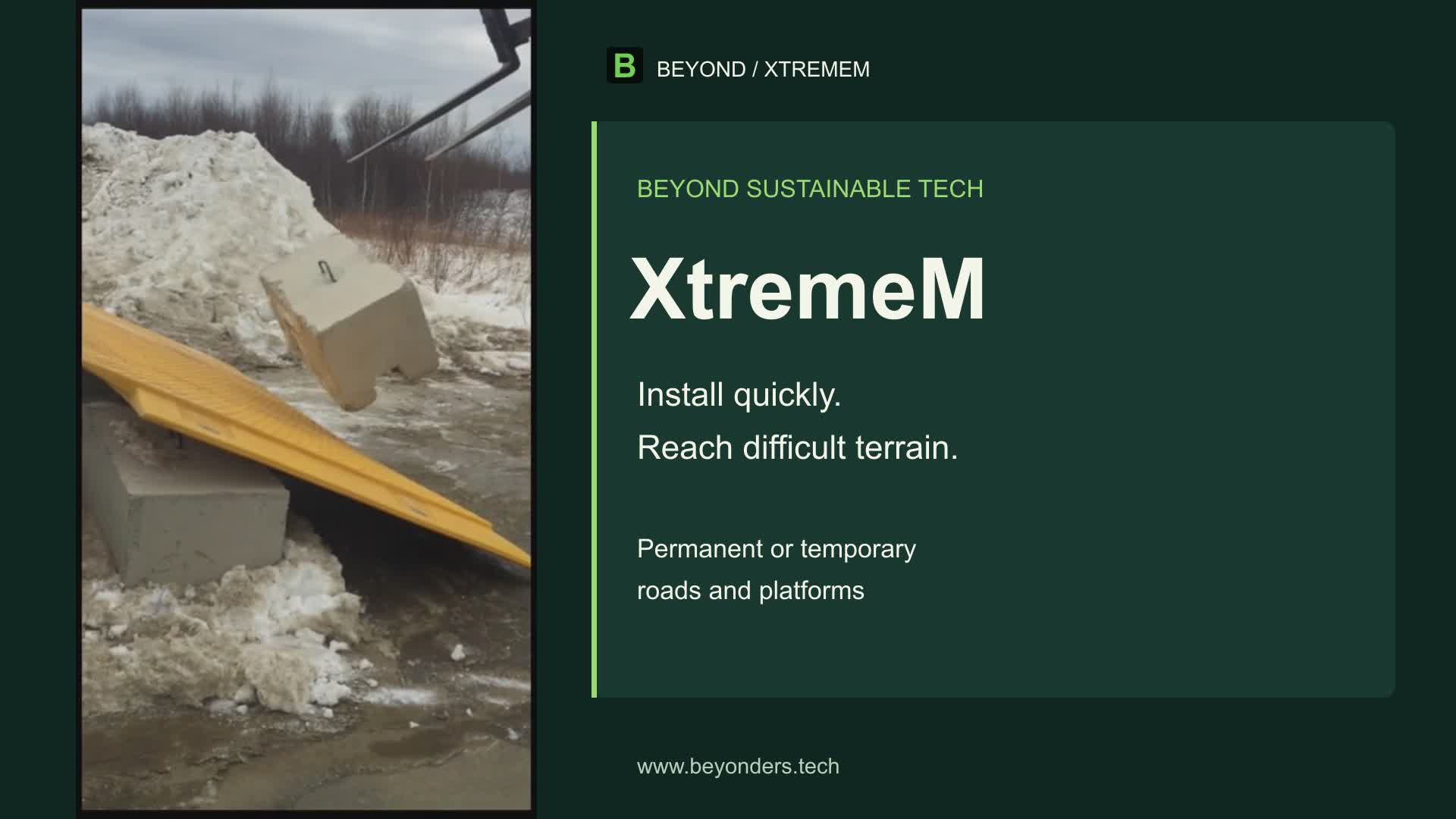 Watch the demonstration and tests
Understand the measurements
Compression acts downwards over a contact area. Lateral force acts sideways on the connected assembly. Both use metric tonnes-force; only compression is expressed per square metre.
Metric tonnes-force per square metre: the published compressive pressure. The “per m²” describes a force divided by contact area, not the total weight of a vehicle.
Metric tonnes-force acting sideways on the described assembly with at least four connectors. This is an additional connection property, not a vehicle weight limit.
Vehicle suitability is assessed from axle loads, tyre or track contact, ground support, installation, traffic and operating conditions.
The signed engineer’s attestation references ASTM D257 or equivalent for electrical resistivity, and ASTM F2329/F2329M-15 for hot-dip galvanizing of the locking parts. These references apply to the stated properties and components.
Rapid installation opens access for crews and equipment across difficult terrain.
For a permanent road, replace a damaged module instead of rebuilding the whole surface.
Leave the road in place for long-term use, then recover, relocate or reconfigure modules as needs change. Depending on the terrain and configuration, a modular road can reduce earthworks and reliance on continuous roadside ditches, helping preserve natural water movement. Fewer drainage structures can also reduce construction and maintenance work. Water crossings, heavy rainfall and environmental requirements are addressed in the project design.
Plan the application
Design depends on ground conditions, load distribution and installation. Underlying support is required. [2, 4]
Pressure: 400 t/m² appears on page 3 of the engineering dossier; it is a pressure in metric tonnes-force per square metre. The displayed conversions (≈ 3.92 MPa and ≈ 569 psi) are calculated from 400 t/m². The source table also lists 600 psi: these values are not exact equivalents. [1]
Cold impact: COR Engineering report dated September 2017, specimen tests at −52 °C (−61.6 °F) using a method adapted to the product. This temperature describes the test conditions, not a service range. [4]
Data from the engineering dossier’s technical data sheet [1]. Confirm the product configuration and nominal data during technical review.
Planning quantities from the engineering dossier’s technical data sheet [1]. Confirm container specification, payload, accessories, loading arrangement and securing before shipment.
A staggered layout and mechanical connections are central to XtremeM. Load distribution is assessed across the system formed by the modules, their connections and the supporting ground. The configuration is adapted to loads, traffic and site conditions.
1 × 10⁸ Ω·cm
Attested minimum threshold
Referenced method: ASTM D257 or equivalent. [3]
ASTM F2329/F2329M-15
C1045 steel locking parts, hot-dip galvanized to this standard. [3]
20 metric tonnes-force
Engineer’s attestation, 13 November 2024: system described with at least four connectors. [3]
Data attested by Louis DeGrâce, P.Eng., on 13 November 2024.
Original PDF in English
ASTM D257 describes methods for measuring electrical resistivity. The minimum threshold of 1 × 10⁸ Ω·cm is the one stated in the letter; the method actually used and the test conditions are not detailed. This value is not an insulation voltage or a qualification for personal protection against electrical hazards.
ASTM F2329/F2329M-15 concerns the hot-dip galvanizing of the locking parts. This reference covers the zinc coating; the letter does not guarantee a duration of corrosion protection.
Lateral load capacity for the assembly described in the attestation. Confirm applicability to the selected assembly.
Assess selected internal access and work areas against equipment loads, wheel or track contact, traffic, slopes, drainage and ground support. Modules require underlying support and must not bridge unsupported voids.
Compression and flexural reports are held in the technical dossier. Relevant reports and approved installation instructions can support the project review. Test results alone do not establish an allowable load for every site or vehicle. [2, 4]
A supply track record
Selected distribution partners and organizations supplied with XtremeM modules.
Supply and distribution references; deployment contexts vary by partner.
Continue exploring
See the module in action, explore our work on water and land, or discuss the requirements of a specific application with our team.
Three-page PDFs · French, English and Spanish
This overview is not an installation manual or a site-specific design approval.